

Your brand is being erased in real time. It's a hard truth. Over 65% of informational searches now end without a single click to a website because AI Overviews are stealing the spotlight. Learning how to prepare website for ai search is no longer optional; it's a survival requirement. If ChatGPT isn't mentioning your name, you don't exist to the 900 million users searching there every week.
You know the frustration of watching organic traffic vanish while your rankings stay static. It feels like the floor is dropping out. We have the solution. This guide provides a definitive framework to win citations in Claude and Perplexity and stop being a digital ghost. We're breaking down our proprietary 0-100 GEO scoring system across six critical categories and showing you how to track every AI mention automatically without paying the $150 plus monthly ransom demanded by legacy SEO tools.
Key Takeaways
- Combat the 65% of informational searches that result in zero clicks by optimizing for AI citations instead of just rankings.
- Learn the technical framework for how to prepare website for ai search, including the implementation of the llms.txt standard and Schema 2.0.
- Master the six pillars of AI visibility to ensure your brand is cited as a niche authority by models like ChatGPT, Claude, and Perplexity.
- Establish a clear baseline for your digital discovery potential using our proprietary 0 to 100 GEO scoring system.
- Monitor your AI mentions automatically for $39.99 a month, a professional alternative to paying $139 or more for legacy platforms like Semrush.
What is Generative Engine Optimization (GEO)?
The era of clicking through ten blue links is over. If you are still measuring success by your Google rank, you are measuring a ghost metric. Today, success is defined by citations in the generated responses of ChatGPT, Claude, and Perplexity. What is Generative Engine Optimization (GEO)? At its core, GEO is the process of optimizing web content to be accurately retrieved and cited by Large Language Models (LLMs).
The landscape has shifted from a library index to an active interview. Traditional search engines like Google built a directory; AI search engines build an answer. This transition has triggered a "Zero-Click Crisis." Recent data shows that over 65% of informational queries are now resolved without the user ever visiting a website. In fact, field experiments have measured a 38% drop in clicks to websites when AI Overviews are present. You can't just rank. You have to be the source that the AI trusts enough to quote.
Why Traditional SEO is Failing Your Brand
Legacy SEO tactics are becoming obsolete. AI Overviews now appear in nearly 55% of all Google searches. This pushes organic results so far below the fold they might as well not exist. This is digital erasure. If an AI model doesn't mention your brand when a user asks for a recommendation, you've been deleted from the consumer's journey. Your authority is invisible.
Keyword stuffing is now toxic. Modern LLMs use reasoning, not just pattern matching. They look for depth, context, and niche authority. If your content is thin or overly optimized for robots rather than logic, the AI will bypass you for a competitor who understands how to prepare website for ai search. You need to feed the model's reasoning, not just its index.
The Birth of the GEO Framework
We are moving from an "index-and-retrieve" model to a "reason-and-generate" model. In the old model, Google found your page and displayed it. In the new model, the AI reads your page, understands the intent, and synthesizes it into a new response. The goal of GEO is to become the "trusted source" for this synthesis. You are no longer just a destination; you are the data source.
GEO is the essential bridge between your proprietary data and an AI’s generated output. At Cobalt Automations, we track this visibility through our proprietary 0-100 GEO scoring system. While competitors like Semrush charge $139 or more for bloated, legacy tools, we provide the first automated AI search visibility monitoring for just $39.99 a month. Don't wait for your traffic to hit zero. Visit cobaltautomations.com for a free GEO audit and secure your place in the AI search revolution.
The 6 Pillars of AI Visibility: How Models Decide to Cite You
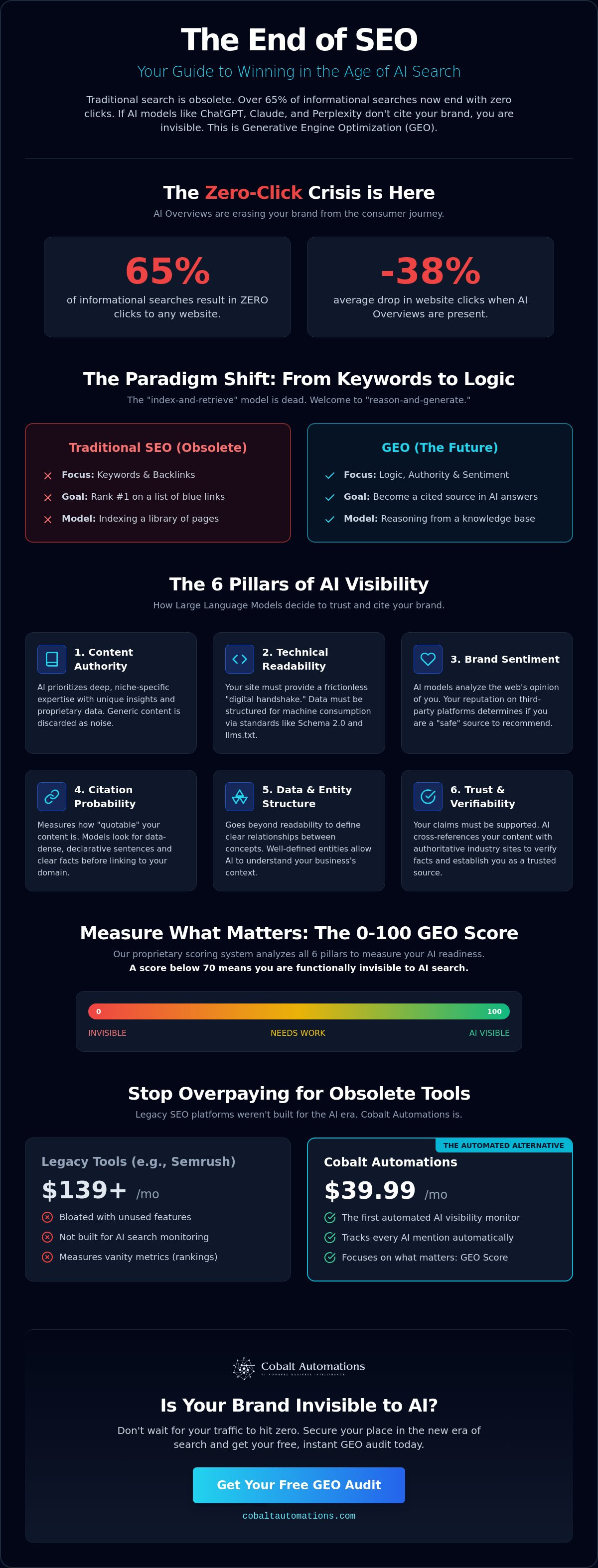
Traditional search engines rewarded keywords. Generative engines reward logic. At Cobalt Automations, we evaluate your digital presence through a proprietary 6-category framework that feeds directly into your 0-100 GEO score. If you aren't scoring above a 70, you are functionally invisible to the models that matter. Learning how to prepare website for ai search starts with understanding these pillars of visibility.
- Category 1: Content Authority. LLMs prioritize deep, niche-specific expertise. Broad generalizations are discarded as noise. If your content doesn't provide unique insights or proprietary data, it won't be retrieved.
- Category 2: Technical Readability. This is the digital handshake. If an LLM crawler encounters friction, it moves on. Your data must be structured for machine consumption, not just human browsing.
- Category 3: Brand Sentiment. AI models don't just read your site; they read the web's opinion of you. They analyze your reputation across third-party platforms to determine if you are a "safe" source to recommend.
- Category 4: Citation Probability. This measures how "quotable" your content is. Models look for specific markers, such as data-dense sentences and clear entity relationships, before deciding to generate a link to your domain.
Optimizing for Authority and Sentiment
Proving expertise requires a shift in tone. Use first-person narratives and unique case studies to anchor your authority. AI models are trained to spot generic, AI-generated filler. They crave "Information Gain," which is the new value you bring to a topic that doesn't exist elsewhere. You must also manage your digital footprint aggressively. Mentions on authoritative industry sites act as a "vibe check" for LLMs, boosting your brand sentiment score. We call these "Citation Magnets." These are fact-dense, declarative sentences that provide immediate answers to complex questions. When you write with high information density, you make it easy for ChatGPT or Claude to quote you directly.
The Role of LLM Crawlers
Your server is now hosting new guests: GPT-Bot and Claude-Bot. These crawlers interact with your site differently than Googlebot. They aren't looking for meta tags; they are looking for raw information density. Site speed and clean HTML are more critical than ever. If your site is bogged down by heavy JavaScript or redundant code, the crawler may timeout or fail to parse your core message. AI crawlers prioritize information density over aesthetic design. They don't care about your hero image or your color palette. They care about how quickly they can extract a factual answer from your code. Understanding this technical shift is a foundational step in how to prepare website for ai search effectively. While legacy tools like Semrush charge $139 plus for outdated metrics, our $39.99 monthly subscription monitors these bot interactions in real time to ensure your 0-100 score stays competitive.
Technical Preparation: Implementing the llms.txt and Structured Data
Technical debt is no longer just a developer's headache. It is a discovery problem. If your site's code is a fragmented mess, AI models like Claude and Perplexity will simply ignore you. This is the bedrock of how to prepare website for ai search at the infrastructure level. You must stop building for humans who browse and start building for models that ingest. If the model can't parse your data, your brand doesn't exist.
"Div soup" is the enemy of Generative Engine Optimization. When you wrap every piece of content in generic, non-descriptive tags, you make it impossible for an LLM to distinguish between a core product feature and a sidebar advertisement. Use semantic HTML. Tags like header, article, and section provide the structural signposts AI needs to extract high-confidence answers. AI Overviews now resolve a massive share of informational queries without a single click. If you want to be the source of that answer, your code must be transparent.
Content chunking is your next priority. Information should be delivered in bite-sized, logical blocks. AI models rarely read your entire page from top to bottom. Instead, they extract specific "chunks" to satisfy a user's prompt. Use clear headings and concise paragraphs to facilitate this extraction. This makes your content "sticky" for AI crawlers looking for immediate, factual data to cite.
How to Build an llms.txt File
The llms.txt file is the new "handshake" for the generative era. While robots.txt is designed to block access, llms.txt is designed to guide it. Think of it as a cheat sheet for AI crawlers. You should host this file in your root directory at yourdomain.com/llms.txt. A standard file should include a brief summary of your business, links to your most authoritative documentation, and clear definitions of your core services. This ensures that when GPT-Bot visits, it receives the official version of your brand story rather than guessing based on fragmented data found elsewhere.
Entity-Based Content Architecture
Keywords are a relic of the 2010s. Modern AI search engines operate on entities. An entity is a distinct, verifiable node in a Knowledge Graph. Your business must be defined as an entity with specific relationships to other trusted sources. Use Schema Markup 2.0 (JSON-LD) to define these relationships explicitly. Don't just list your services. Use Schema to link your brand to industry categories, specific founders, and verified third-party reviews. This builds a "trust network" that AI models use to verify your authority. You can see these structures in action by reviewing Cobalt Automations examples. Our automated monitoring service tracks these technical markers to ensure your 0-100 GEO score remains competitive. For $39.99 a month, we identify the technical blind spots that $139 legacy tools completely miss. Secure your technical foundation before the models move on without you.
The 0-100 GEO Scoring System: Measuring Your AI Search Readiness
Traditional metrics are dead. Impressions don't pay the bills if the AI summary answers the question before the user ever clicks. In 2026, the only number that defines your market relevance is your 0-100 GEO score. This proprietary metric quantifies your visibility within the generative engines that now control 25% of organic search traffic. If you want to know how to prepare website for ai search, you must start with a hard look at the data. You cannot manage what you do not measure.
The process begins with a baseline audit. We analyze your current mentions across ChatGPT and Perplexity to see if you are being cited or erased. Next, we evaluate your infrastructure against the 6 pillars of AI visibility. This diagnostic reveals your blind spots. A blind spot is where an AI model misrepresents your services or ignores your brand entirely in favor of a competitor. Once identified, you can implement corrective GEO optimizations to reclaim your authority. It is a logical, step-by-step path from invisibility to market leadership.
Automated Monitoring vs. Manual Guesswork
Don't trust your own phone. Manual prompt-checking is a trap. Your personal ChatGPT results are biased by your search history, location, and account settings. You see a skewed reality. Tracking brand visibility in AI search is a full-time job for software, not humans. Automated monitoring tracks thousands of prompt permutations across different regions and models. This provides a true, unbiased visibility score that reflects what the rest of the world actually sees. Accuracy is the difference between a strategy and a guess.
Pricing the Future: Why GEO is More Affordable than SEO
Traditional SEO tools are bloated and overpriced. Legacy platforms like Semrush charge $139 or more every month for metrics that matter less with every AI update. Cobalt Automations offers a lean, high-impact alternative. Our GEO monitoring subscription is only $39.99 a month. We use automation to lower the barrier to entry for small businesses in Pooler and beyond. The ROI of AI readiness is undeniable. One high-intent AI citation is worth 1,000 traditional impressions. An impression is just a glance. A citation is a direct endorsement from the engine the user trusts. Stop flying blind. Get your free GEO audit today and discover your real AI visibility score.
Cobalt Automations: Your Partner in the AI Search Revolution
Traditional visibility is a relic. Your brand is either the definitive answer or it is invisible. The Cobalt Mission is simple: ensure no business is left behind as search engines evolve into answer engines. We've moved past the era where "good content" was enough. Today, you need precision engineering. You need to know exactly how to prepare website for ai search to survive the shift toward zero-click discovery.
We provide the tools to navigate this new reality without the bloated costs of legacy SEO agencies. Our GEO Monitoring Subscription delivers real-time tracking of your proprietary 0-100 visibility score. While others guess, we use data to show you exactly where you stand in the eyes of ChatGPT, Claude, and Perplexity. We also provide website creation geo optimized from the ground up. We don't just build sites for humans; we build them for the models that recommend those humans. This ensures your brand is baked into the AI Knowledge Graph from day one.
Stop the Erasure: Secure Your AI Visibility
The stakes couldn't be higher. The window to claim your space in the AI Knowledge Graph is closing as models solidify their "trusted" sources. Once a model decides a competitor is the authority in your niche, displacing them becomes exponentially harder. Our proprietary technology identifies the specific linguistic triggers and data structures that force AI citations. We turn your expertise into a format LLMs can't ignore. Don't let your brand be erased by a machine's lack of data. You can visit cobaltautomations.com right now to claim your free GEO audit and see your current score.
Custom GEO Solutions for Modern Brands
We build websites that bypass traditional SEO hurdles entirely. Our process focuses on information density and entity-based architecture. This isn't about chasing the latest Google algorithm update. It's about being an early adopter in the GEO space. Early adopters capture the lion's share of AI citations before the market becomes saturated with noise. We offer this automated monitoring for just $39.99 a month. Compare that to the $139 plus you'd pay for a tool like Semrush that doesn't even track AI mentions. It's an easy choice. Don't wait until your organic traffic hits zero. The roadmap for how to prepare website for ai search is clear. The only question is whether you'll act before your competitors do. Secure your future at cobaltautomations.com today.
Secure Your Authority Before the AI Knowledge Graph Closes
The search landscape has shifted permanently. Traditional SEO is a relic. You now understand the technical requirements and the six pillars of AI visibility. Success depends on your 0-100 GEO score. It's about winning citations, not just clicks. This is exactly how to prepare website for ai search before the Knowledge Graph locks you out. You can't afford to be a digital ghost while your competitors claim the spotlight.
Don't settle for digital erasure. Legacy tools charge $139 plus for data that ignores AI search engines. We offer automated monitoring for just $39.99 a month. Cobalt Automations specializes in Generative Engine Optimization (GEO) because your authority is too valuable to lose. The window for early adoption is closing fast. Act now to ensure your data is the data that AI models trust and recommend to your future customers.
Claim Your Free 0-100 GEO Audit at Cobalt Automations. Your market relevance starts here.
Frequently Asked Questions
Is GEO different from SEO?
Yes. SEO focuses on ranking in a list of blue links. GEO focuses on being the cited source within an AI-generated response. It is the difference between appearing in a library index and being the expert cited in a conversation. While SEO targets search bots, GEO targets Large Language Model (LLM) reasoning.
How much does it cost to prepare my website for AI search?
The cost depends on your site's current technical debt. However, monitoring your progress is now affordable. While legacy tools charge high fees for outdated metrics, we provide automated visibility tracking for $39.99 a month. This is the most efficient way to understand how to prepare website for ai search without wasting thousands on manual audits.
Will my current SEO agency know how to do GEO?
Likely not. Most agencies are still using a 2018 playbook. They focus on keyword volume and traditional backlinks. GEO requires a fundamental shift to entity-based architecture and information density. If your agency isn't discussing the llms.txt standard or your 0-100 GEO score, they are leaving you invisible.
Can I track how often ChatGPT mentions my business?
You can, but manual checking is a trap. Your personal results are biased by your search history. Our software automates this process by running thousands of prompt variations across different models. This gives you an unbiased view of your brand citations compared to your competitors.
What is a good GEO score for a local business?
You should aim for a score of 70 or higher. Our proprietary 0-100 scoring system evaluates your business across six critical categories. A score below 70 indicates significant "blind spots." This means AI models are likely recommending your competitors because they can't verify your authority.
Do I need to rewrite all my content for AI search?
No. You need to optimize it. This involves "chunking" your data and adding fact-dense "Citation Magnets" that LLMs love to quote. It is a surgical update to your existing pages. The goal is to ensure LLM crawlers like GPT-Bot can parse your expertise without friction.
How does Cobalt Automations differ from tools like Semrush?
We are a specialized, automated alternative for the generative era. Legacy tools like Semrush charge $139 or more for metrics that ignore AI search engines. We track AI visibility and citations for $39.99 a month. We monitor the engines that actually drive discovery in 2026.
What happens if I ignore GEO in 2026?
Digital erasure. AI assistants and chatbots now handle roughly 25% of organic search traffic. If you aren't the cited source in these answers, you don't exist to those users. Ignoring GEO means watching your organic traffic drop by 20% to 40% while your competitors claim the Knowledge Graph.