
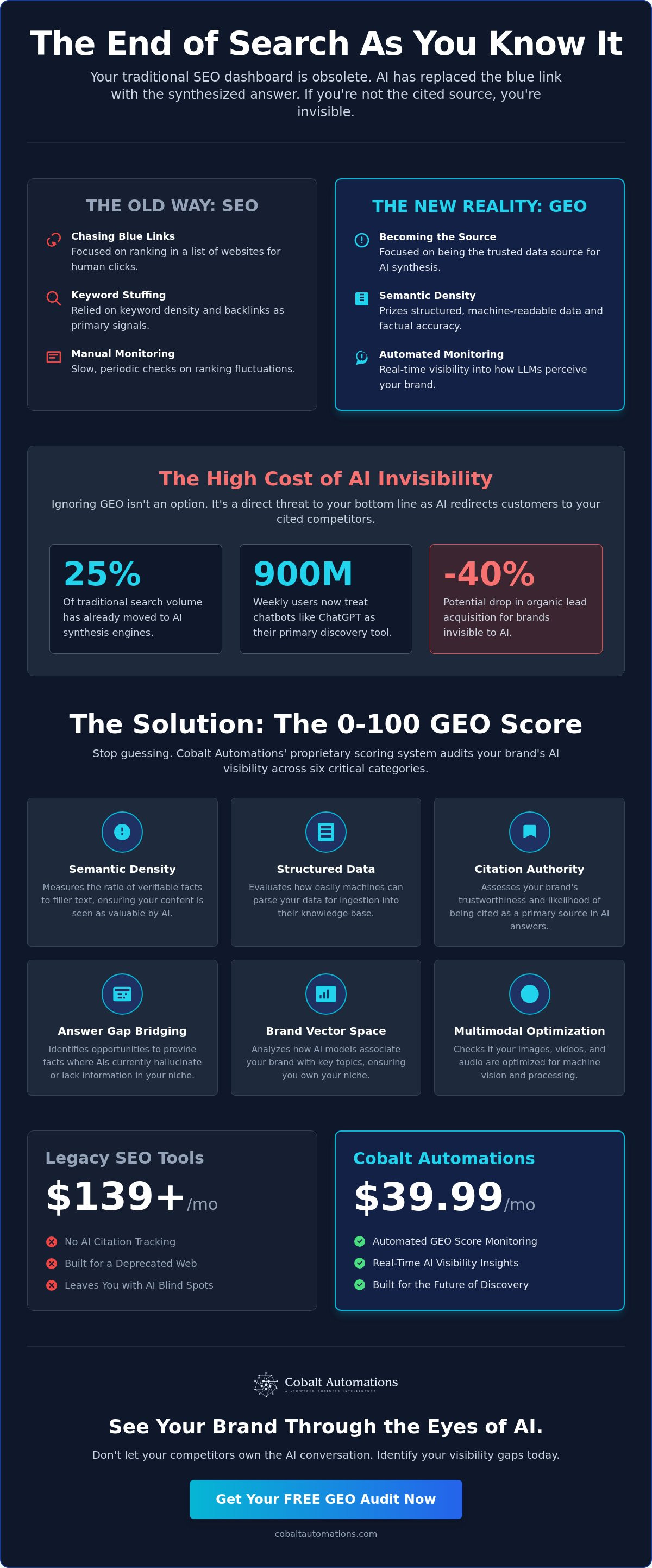
Your traditional SEO dashboard is lying to you. While you're chasing rankings on a page of blue links, 25% of your search volume has already vanished into the black box of AI synthesis. If your brand isn't being cited by GPT-5.5 or Gemini 3, you're effectively invisible to the 900 million weekly users who now treat chatbots as their primary discovery tool. You need a generative engine optimization strategy that treats LLMs as the new gatekeepers of your revenue. Visibility is no longer about keywords. It's about being the data source the machine trusts.
It's exhausting to watch your click-through rates decline while you're stuck paying $139 or more for legacy tools that don't track AI metrics. We understand the frustration of having zero transparency into how AI models perceive your authority. This article provides the roadmap to fix that. You'll learn how to master the shift from traditional search to AI synthesis with a data-backed strategy that secures your brand’s presence. We will break down our proprietary 0-100 GEO scoring system and show you how to monitor your visibility across six critical categories for just $39.99 a month.
Key Takeaways
- Stop chasing blue links. Search has evolved into synthesis, and if your brand isn't the cited source, it's invisible to the 900 million users on ChatGPT.
- Deploy a data-backed generative engine optimization strategy that prioritizes semantic density and structured data to win over non-human readers.
- Use our proprietary 0-100 GEO scoring system to evaluate your brand across six specific categories and identify your AI blind spots immediately.
- Master citation-first architecture to bridge "Answer Gaps" where current AI models are hallucinating or missing facts about your industry.
- Transition to automated, real-time visibility monitoring to ensure your brand stays in the conversation as LLMs update their knowledge bases.
The Death of the Blue Link: Why Generative AI Search Engine Optimization is Mandatory
The era of the "blue link" is over. In 2026, search is no longer a scavenger hunt for a website; it's a demand for a synthesized answer. Traditional SEO is failing because AI engines like Gemini 3 and GPT-5.5 Instant bypass the click entirely. They provide the solution directly in the interface. This "Zero-Click" crisis isn't a future threat. It's a current reality where visibility outweighs traffic volume. If you aren't the answer, you're the background noise.
Defining your generative engine optimization strategy is now a requirement for brand survival. GEO is the process of optimizing your brand's digital footprint so it is ingested, trusted, and cited by Large Language Models. While traditional SEO focused on human clicks, GEO focuses on machine synthesis. You're no longer competing for a spot in a list. You're competing to be the foundation of the AI's response.
From Indexing to Ingestion: How LLMs See You
Models like ChatGPT and Claude don't "search" the web like a librarian. They ingest data to build a probabilistic knowledge base. This shift relies heavily on Generative AI technology and Retrieval-Augmented Generation (RAG). RAG allows an AI to pull specific, real-time facts from the web to ground its answers. If your content is "fluff" or lacks semantic density, the RAG process skips you. Your old SEO authority, built on backlinks and keyword stuffing, doesn't translate to AI trust. Machines look for structured data and factual citations, not just popularity.
The High Cost of AI Erasure
Being invisible in AI responses is a death sentence for brand awareness. You might rank #1 on a traditional Google search, but if you have a 0% citation rate on Perplexity, your competitors are winning every conversation. This is the "Invisible Brand" syndrome. It happens when your data isn't machine-readable or lacks the authority signals LLMs require. You don't just lose traffic; you lose the opportunity to be considered as a solution.
For a mid-sized firm, the financial impact of AI invisibility can manifest as a 40% drop in organic lead acquisition as AI assistants redirect potential customers toward cited competitors.
You can't fix what you don't measure. Most legacy tools cost $139 or more per month and still don't track these AI metrics. Cobalt Automations provides a proprietary 0-100 GEO scoring system that evaluates your visibility across six specific categories for just $39.99 a month. It's time to stop guessing and start monitoring. You can get a free GEO audit at cobaltautomations.com to see exactly where your brand stands in the new search landscape.
The Mechanics of Authority: How Generative Engines Map Your Brand
AI doesn't browse. It digests. When an LLM scans your site, it isn't looking for clever wordplay; it's looking for semantic density. This is the ratio of verifiable facts to filler text. In the era of generative discovery, fluff is fatal. Your generative engine optimization strategy must prioritize "fact-dense" content that provides immediate, extractable value to a transformer model. If an AI can't parse your solution in milliseconds, it will hallucinate a competitor's answer instead.
Citation triggers are the new backlinks. An LLM decides to link to your source when it finds high semantic connectivity between your data and the user's intent. Despite the risks of generative search regarding hallucinations, models prioritize sources that offer structured evidence. They want proof, not promises. Furthermore, discovery is now multimodal. AI systems "see" your images and "hear" your videos by processing their metadata and transcripts. If your visual assets aren't optimized for machine vision, you're leaving half your visibility on the table.
Semantic Connectivity and Brand Association
AI models place your brand in a "Vector Space." Think of this as a digital map where your business is positioned near specific topics. If you target broad keywords, your position is blurry. Niche expertise creates a sharp, high-authority coordinate that AI engines trust. By dominating a specific solution category, you ensure that when a user asks for an expert, the AI maps directly to you. It's about being the definitive source for a specific problem, not a generalist for a thousand queries.
Technical Readiness for AI Crawlers
Your site architecture must be a "truth source." This requires aggressive use of JSON-LD and schema markup. This isn't just technical housekeeping; it's providing a machine-readable resume for your brand. JSON-LD allows you to hand-feed facts to AI crawlers, ensuring they don't have to guess your pricing, location, or service details. Check out our GEO optimized website examples to see this architecture in action.
Legacy SEO tools often miss these technical nuances. They're built for a world that no longer exists. Why pay $139 or more per month for tools like Semrush when they don't track the six specific categories that define your AI visibility? Cobalt Automations offers automated monitoring for just $39.99 a month. We help you identify blind spots in your technical readiness before they turn into lost revenue. You can find out where you stand by getting a free GEO audit today.
Auditing Your Presence: The Proprietary 0-100 GEO Scoring System
Traditional SEO metrics are obsolete. Domain Authority and keyword rankings mean nothing if an AI assistant never mentions your brand. You're likely still paying $139 or more every month for legacy tools like Semrush or Ahrefs. These platforms are blind to the LLM landscape. They track links; they don't track synthesis. To survive, your generative engine optimization strategy must be guided by data that actually reflects how AI models perceive your authority. You can't optimize what you can't see.
Understanding how GenAI search differs from legacy search is the first step toward effective measurement. Cobalt Automations replaces guesswork with our proprietary 0-100 GEO scoring system. This framework doesn't just count clicks. It evaluates your brand's standing within the black-box environments of ChatGPT, Claude, and Perplexity. At just $39.99 a month, our monitoring solution provides the transparency you need to stop being an invisible brand. It's a digital wake-up call for your marketing department.
The 6 Pillars of the GEO Score
Our evaluation framework breaks down your AI presence into six distinct categories. This diagnostic approach allows you to identify exactly where your strategy is leaking authority. We focus on critical metrics that legacy tools ignore:
- Citation Frequency: This measures how often AI engines cite your brand as a primary source. If you aren't being cited, you don't exist in the answer.
- Sentiment Alignment: We track whether the AI describes your brand using the specific language and context you desire. It's about controlling your narrative in a generative world.
- Category Dominance: This is your share of voice in AI-generated industry comparisons. When a user asks for the "best" in your niche, are you the first recommendation?
Benchmarking Against the Competition
The 0-100 score is your competitive radar. It shows you exactly which competitors are "stealing" your citations and which content gaps they are exploiting. In an era where traditional search volume is dropping by 25%, you can't afford to guess your market position. This score gives you the leverage to justify marketing spend to executives by showing real-time visibility gains. Ai visibility is the leading KPI for 2026 because it represents your brand's share of the only search market that is actually growing. Don't leave your discovery to chance. Get your free GEO audit now at cobaltautomations.com and see your score.
Strategic Content Engineering: Moving from Keywords to Citations
Ranking on page one is now a vanity metric. If the AI doesn't cite you, the user never sees you. Your generative engine optimization strategy must shift from keyword targeting to citation engineering. Success in 2026 is measured by how often your brand serves as the factual foundation for an LLM's response. Referral traffic from AI search converts at 14.2%, which is five times higher than traditional organic search. You aren't just writing for readers; you're engineering data for ingestion.
To secure your presence, follow this four-step engineering process:
- Step 1: Identify Answer Gaps. Locate queries where Gemini 3 or GPT-5.5 currently hallucinate or provide thin data. These are your entry points.
- Step 2: Citation-First Architecture. Build content around verifiable claims. Every paragraph should serve as a standalone "truth block" that a RAG system can easily retrieve.
- Step 3: Deep-linking. Use internal and external links within fact-dense sections to provide a map of authority. This signals to the AI that your data is grounded in a broader network of trust.
- Step 4: Verify Ingestion. Use an ai search visibility tool to confirm that the models are actually "seeing" and citing your updates.
The "Hook-and-Sting" Editorial Method
AI models favor punchy, declarative statements. Avoid technical jargon that fragments word tokenization and confuses the model's association logic. Instead, use a "hook-and-sting" structure: lead with a bold, factual claim and follow it with a sobering consequence. Why use complex language when simple, high-density facts win the citation? Ask rhetorical questions that mirror common user prompts. This creates a direct semantic match between the user's intent and your content's solution.
Formatting for LLM Preference
Structure is the language of machines. Use lists, tables, and bullet points to facilitate "snippet" extraction. AI models are programmed to summarize; if your content is a wall of text, you will be ignored. How-to content must be engineered with clear, step-by-step logic that allows an AI to generate a concise summary without losing your brand's attribution. Cite real statistics to ground your claims. This increases your authority score in our proprietary 0-100 GEO evaluation framework.
Stop wasting $139 or more per month on legacy SEO tools that can't track these citations. Cobalt Automations provides automated AI visibility monitoring for just $39.99 a month, giving you the transparency to see exactly which content is being cited and where you are invisible. You can start engineering your visibility today by getting a free GEO audit at our main site.
Real-Time Visibility: Why Manual GEO is a Losing Game
Manual tracking is a fool's errand. AI models like GPT-5.5 and Gemini 3 are not static indexes; they are dynamic, evolving entities. They update their knowledge bases and retrieval weights constantly. If your generative engine optimization strategy relies on manual checks or monthly audits, you've already lost the race. A single model update can erase your brand from the "answer box" in seconds. You won't see this shift in your legacy SEO tools. You'll only see it in your declining lead volume.
Cobalt Automations acts as your digital firewall against this erasure. Automated monitoring is the only way to catch brand invisibility before it impacts your bottom line. We provide the transparency that traditional platforms refuse to offer. While your competitors are stuck in a "set and forget" mindset with their content, you'll be tracking exactly how the machines perceive your authority in real-time. If the AI stops citing you, you'll know why before the day is over.
The $39.99/mo Advantage
Enterprise-grade AI tracking shouldn't be a luxury reserved for the top 1%. We've broken the pricing barrier. Most legacy SEO platforms charge $139 or more every month for data that is effectively obsolete in an AI-first world. Cobalt Automations provides a GEO Monitoring Subscription for just $39.99 a month. This isn't just a tool; it's an insurance policy for your discovery. You get automated weekly reports, real-time tracking of your 0-100 GEO score, and instant alerts when a competitor starts stealing your citations. Stop guessing and start tracking.
Next Steps: Securing Your Brand’s Future
The transition from SEO to GEO is a winner-takes-all scenario. AI models favor the most authoritative, fact-dense sources they can find. Once an LLM establishes a citation pattern for a specific category, displacing that incumbent becomes exponentially harder. You are either the cited source or you are invisible. There is no middle ground in 2026. Identifying your current blind spots is the first step toward reclaiming your market share.
Don't wait for your traffic to hit zero before you take action. Get a free GEO audit at cobaltautomations.com today. We will evaluate your brand across our six proprietary categories and provide a clear roadmap to secure your visibility. Your brand's survival depends on being part of the synthesized answer. Secure your spot now and stop being ignored by the engines that drive modern discovery.
Stop the Erasure: Your Brand's Next Move
The transition from blue links to AI synthesis is not a choice; it's an ultimatum. If your brand isn't being cited by ChatGPT or Gemini, you're losing market share to competitors who understand the new rules. A robust generative engine optimization strategy isn't just about content. It's about engineering your data to be machine-readable and authoritative. You've seen the mechanics of authority and the failure of legacy tools to track these shifts. Now, you need the visibility to act.
Cobalt Automations is the first automated AI visibility tracker. We offer a proprietary 0-100 scoring system that reveals exactly where you stand across six critical categories. For only $39.99/mo, you can replace the $139/mo blind spots of traditional tools with real-time transparency. Don't wait for your brand to become a ghost in the LLM landscape. It's time to reclaim your presence and command the conversation. Get Your Free GEO Audit and Stop the Erasure today. Your future discovery starts with the data you own.
Frequently Asked Questions
What is the main difference between SEO and Generative Engine Optimization?
SEO targets a list of blue links; GEO targets the synthesized answer generated by an AI model. While SEO focuses on clicks, a generative engine optimization strategy focuses on being the primary data source that the AI trusts and cites. You aren't just competing for a position. You're competing to be the foundation of the machine's response.
How much does a GEO monitoring subscription cost compared to traditional SEO tools?
Cobalt Automations provides automated AI visibility tracking for $39.99 per month. Traditional SEO tools like Semrush often cost $139 or more monthly and still fail to track LLM metrics. We've made enterprise-grade AI monitoring affordable for every business owner because you shouldn't have to overpay for obsolete data.
Can I use my existing SEO content for GEO, or do I need to rewrite everything?
You don't need to start from scratch, but your content needs to be engineered for ingestion. AI models look for fact-dense blocks and structured data rather than long-form fluff. We help you identify "Answer Gaps" where your existing content can be restructured with a citation-first architecture to win over RAG systems.
How does the 0-100 GEO scoring system actually work?
It evaluates your brand across six specific categories, including Citation Frequency and Sentiment Alignment. This score provides a quantitative look into a black-box environment where traditional rankings don't exist. It's a diagnostic tool that tells you exactly where your brand is visible and where it has been erased by the AI.
Which AI engines does Cobalt Automations track?
We monitor visibility across the primary drivers of modern discovery, including ChatGPT, Perplexity, Google AI (Gemini 3), and Claude. These platforms represent the shift away from traditional search. If your brand is invisible on these four engines, you're missing out on nearly 20% of all digital queries as of 2026.
How long does it take to see results from a generative ai search engine optimization strategy?
Results can appear faster than traditional SEO because AI models update their knowledge bases and retrieval weights constantly. While Google core updates might take weeks, a well-engineered citation can be ingested and reflected in AI responses within days. The key is real-time monitoring to catch these shifts as they happen.
Is GEO only for large national brands, or can local businesses benefit too?
Local businesses are actually at the highest risk of being overlooked by AI assistants. When a user asks for a recommendation, the AI synthesizes an answer based on trusted local data. If your local business isn't optimized for these engines, you're invisible to the most high-intent customers in your area. Get a free audit at cobaltautomations.com to see your local standing.
What happens if I ignore GEO and keep focusing only on traditional Google search?
You risk total brand erasure as traditional search engine volume is projected to decrease by 25% by the end of 2026. Focusing only on Google links while ignoring AI synthesis is like optimizing for the yellow pages in the era of the smartphone. You'll keep your rankings on a page that fewer people are visiting every day.