
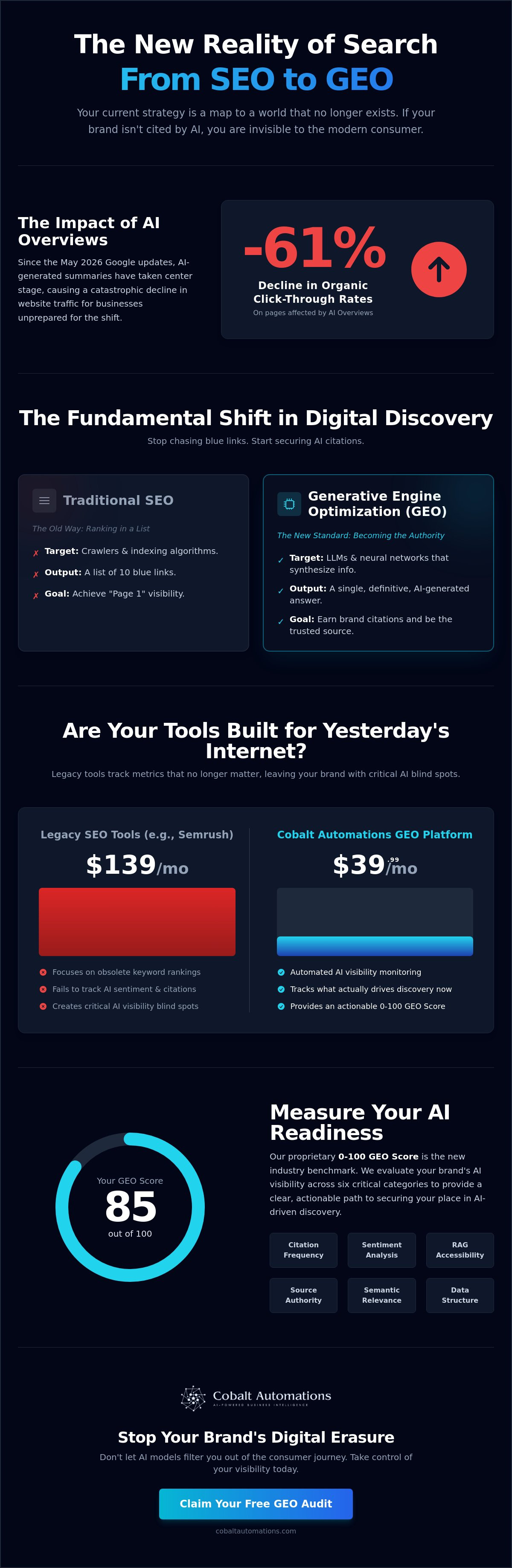
Your current SEO strategy is a map for a world that no longer exists. If your brand isn't appearing in the AI summary, you're effectively invisible to the modern consumer. It's a digital erasure that traditional tactics cannot fix. You've likely noticed your traffic slipping since the May 2026 Google updates. You aren't alone. Recent data confirms that AI Overviews have slashed organic click-through rates by as much as 61 percent on affected pages. This is the new reality of search.
It's time to stop chasing blue links and start securing AI citations. You're about to master the core definition of GEO and learn how to stop AI models from erasing your brand in 2026. We will break down the mechanics of AI discovery and examine practical generative engine optimization examples to help you regain your authority. You'll also learn how to use our proprietary 0-100 GEO scoring system to audit your visibility across six critical categories. This is your framework for staying relevant in an AI-driven market.
Key Takeaways
- Master the strategic shift from ranking in a list to earning citations and authority within AI-generated responses.
- Identify the blind spots in legacy tools like Semrush that charge $139 monthly but fail to track AI sentiment.
- Review real-world generative engine optimization examples to see how RAG mechanics connect your website directly to AI models.
- Measure your brand's AI readiness using our proprietary 0-100 GEO scoring system across six specific categories.
- Secure automated AI monitoring for $39.99 a month and claim a free GEO audit at cobaltautomations.com to stop your erasure.
What is Generative Engine Optimization (GEO)?
2026 is the year search discovery changed forever. If your brand isn't mentioned in a ChatGPT summary or a Google AI Overview, you've effectively been erased from the digital marketplace. This isn't a future threat; it's a current reality. To survive this shift, you must understand What is Generative Engine Optimization (GEO)?. At its core, GEO is the strategic engineering of content to ensure your brand is cited and prioritized by Large Language Models (LLMs). It represents the evolution from "ranking" in a list to becoming the "authority" within an AI-generated answer.
Traditional SEO was built for crawlers that index pages. GEO is built for models that synthesize information. When an AI engine like Perplexity or Claude generates a response, it doesn't just look for keywords. It looks for semantic relevance and trust. If you aren't optimized for these models, the AI filters you out. You become a blind spot in the consumer's journey. By studying successful generative engine optimization examples, it becomes clear that visibility now depends on how well an LLM can retrieve and cite your specific data points to satisfy a user's query.
The Core Difference: SEO vs. GEO
- Targeting: SEO targets algorithms that index static pages. GEO targets neural networks that synthesize complex information.
- Output: Traditional search gives the user a list of links to click. AI search provides a single, definitive answer.
- Visibility: In the old world, "Page 1" was the goal. In the GEO era, if the LLM doesn't mention your brand name in its summary, your ranking is worthless.
Why Traditional Search is Dying
The "blue link" era is over because user behavior has fundamentally pivoted. People no longer want to hunt through ten different websites to find a simple answer. They want a summary. The data backs this up. Since the May 2026 Google updates, AI Overviews now appear in approximately 50 percent of all informational queries in the U.S. This shift has been catastrophic for traditional traffic. Recent reports show that organic click-through rates have plummeted by as much as 61 percent on pages where AI summaries take center stage. If you're still relying on old tactics, you're fighting for a shrinking slice of the pie.
This is why legacy tools like Semrush, which can cost you $139 or more every month, are becoming obsolete. They track keyword positions in a world that is moving toward conversational answers. Cobalt Automations offers a $39.99 monthly subscription that provides the automated AI visibility monitoring you actually need. We utilize a proprietary 0-100 GEO scoring system to evaluate your brand across six critical categories. We don't just tell you where you rank; we show you how to stop being invisible to the engines that actually drive discovery. Visit cobaltautomations.com today for a free GEO audit and see your real score.
How Generative Engines Work: The Mechanics of Discovery
If you think AI search is just a faster version of Google, you've already lost the game. Google indexes pages; AI synthesizes information. Understanding the mechanics of discovery is the difference between being a cited authority and being a ghost in the machine. As of January 2026, ChatGPT's market share sits between 64 and 68 percent. This massive user base isn't clicking through lists of links. They are reading synthesized answers powered by hardware like NVIDIA's AI chips, which currently hold an 81 percent market share. To influence these answers, you must understand the plumbing of the models themselves.
The Three Types of AI Engines
Not all AI discovery happens the same way. Training-based systems like Llama rely on static knowledge from massive datasets. If your brand wasn't prominent during their last training cutoff, you don't exist to them. Search-based systems like Perplexity browse the web in real-time to create summaries. The most dangerous shift for business owners is the rise of hybrid systems. Models like Gemini and SearchGPT combine deep training with real-time retrieval. These are the engines that decide if your brand is worth a citation or if it should be filtered out entirely.
The RAG Process Explained
Retrieval-Augmented Generation (RAG) is the bridge between an AI model and your website. When a user asks a question, the AI "retrieves" relevant data from the web to "augment" its internal knowledge. It then generates a response. If your content isn't "digestible" for AI crawlers, the RAG process will skip you. This isn't about keyword density. It's about semantic clarity and data formatting. Your content must fit within the "context window," which is the limited amount of information an AI can process at one time. If your site is bloated or poorly structured, you'll never make the cut.
Structure now matters more than keywords. Effective generative engine optimization examples show that AI models prioritize content that provides clear, authoritative answers in a format they can easily parse. While legacy tools like Semrush charge $139 monthly to track outdated metrics, they offer zero insight into the RAG process. You need to know how these models see you. Understanding your current standing is the first step toward visibility. You can benchmark your AI readiness with a free audit today to see where your blind spots are hiding.
The transition from traditional search to AI-driven discovery is happening faster than most realize. By focusing on how LLMs retrieve and synthesize data, you can force your brand back into the conversation. We use our proprietary 0-100 GEO scoring system to ensure your website structure is optimized for these specific AI mechanics. Don't let your brand be erased by a context window. Start monitoring your AI visibility for just $39.99 a month and take control of your discovery before the competition catches up.
Why Your Current SEO Strategy is Creating AI Blind Spots
You are likely celebrating a #1 ranking on Google while your sales are quietly dying. This is the "Invisible Brand" syndrome. Traditional SEO is a legacy system designed for a world where humans clicked blue links. In 2026, humans read AI-generated summaries. If ChatGPT, Claude, or Perplexity provides a definitive answer and fails to mention your brand, your ranking is a vanity metric. It provides zero value to your bottom line. You are winning a game that is no longer being played.
The problem is that your current toolkit is obsolete. Legacy platforms like Semrush are built to track keyword strings, not AI sentiment. They are blind to how an LLM synthesizes your brand's authority. An AI model doesn't care about your keyword density; it cares about whether your content provides the most authoritative "fact" to retrieve for its response. When we examine successful generative engine optimization examples, the focus is always on semantic clarity and structured data, not string matching. Manual monitoring is a recipe for obsolescence in a 24/7 AI world where models update their retrieval patterns constantly.
The Failure of Keyword Tracking
AI understands intent and context, not just words. Traditional tools fail to see what the AI is actually saying about you or, worse, if it is hallucinating your brand out of existence with incorrect data. If an AI engine associates your brand with the wrong service or ignores you entirely, no amount of "backlinks" will fix the problem. You need to monitor how these models perceive your semantic authority across the six specific categories we track in our proprietary 0-100 GEO scoring system.
The High Cost of Invisibility
The cost of these blind spots is measurable in lost revenue. With AI Overviews appearing in 50 percent of informational queries, the traditional search traffic you rely on is evaporating. Competitors who have already pivoted to GEO are stealing your "AI Share of Voice." They are becoming the cited sources while you remain a footnote. By analyzing generative engine optimization examples from market leaders, it's clear that those who fail to adapt lose their market relevance almost instantly. You can read more about the financial impact in our analysis of The High Cost of Ignoring GEO Optimization in 2026.
Stop paying $139 or more for tools that ignore the AI revolution. Cobalt Automations provides the first automated AI search visibility monitoring service for just $39.99 a month. We help you identify these blind spots before they become fatal to your business. Don't wait until your organic traffic hits zero. Visit cobaltautomations.com today for a free GEO audit and see your real score.
The GEO Framework: Measuring Visibility with the 0-100 Score
Managing what you cannot measure is a hallmark of a failing strategy. Most businesses are flying blind in the AI era because they lack a standardized metric for visibility. While competitors like Mangools suggest you manually check your performance in ChatGPT, this approach is both amateur and dangerous. AI models aren't static. Their weights and retrieval patterns shift constantly. You need a data-driven framework that translates the chaos of LLM behavior into a single, actionable KPI. This is why we developed the proprietary 0-100 GEO scoring system.
A single score is the only way for executives to track progress without getting bogged down in technical noise. It provides a clear baseline for your current AI readiness. If you're sitting at a 20/100, you are effectively invisible to the 50 percent of informational queries now handled by AI Overviews. Moving your brand to a 90/100 requires more than just content updates. It requires technical GEO optimization that aligns your site structure with how models synthesize data. When we analyze successful generative engine optimization examples, the common thread is always a high score across all six of our critical categories.
The Six Pillars of AI Visibility
- Citation Frequency: How often the model explicitly mentions your brand name.
- Sentiment Analysis: Whether the AI recommends your brand or merely lists it as a generic option.
- Source Authority: The level of trust the AI places in your domain as a primary source of truth.
- Contextual Relevance: How well the AI understands your brand's specific niche and expertise.
- Semantic Alignment: The match between your content's structure and the model's retrieval intent.
- Brand Share of Voice: Your brand's dominance in AI responses compared to your direct competitors.
Why Automated Scoring Beats Manual Audits
AI models update their weights constantly. A manual audit is obsolete by next week. You can't afford to rely on "one-off" reports when the landscape shifts every time a model like Claude or Gemini releases an update. Legacy tools like Semrush charge $139 or more per month for data that ignores these AI pillars entirely. They are tracking a world that is disappearing. Cobalt Automations GEO Monitoring is the first automated solution that tracks your visibility in real-time for just $39.99 a month.
Our platform provides the transparency you need to stop guessing and start growing. By monitoring your score daily, you can identify which technical changes actually move the needle. Don't let your brand's discovery be left to chance. You can benchmark your current AI authority right now. Visit cobaltautomations.com for a free GEO audit and see your real score today.
Implementing GEO: From Definition to Discovery
Understanding the problem is only half the battle. Execution is where most brands fail. If you're still relying on manual analysis to see what ChatGPT says about you, you've already lost. Competitors suggest manually analyzing what gets cited in your niche. That's too slow. In the 2026 search environment, models update their retrieval logic in real-time. You need a systematic, automated approach to reclaim your visibility. Discovery doesn't happen by accident; it's engineered.
Your first step is establishing a baseline. You can't fix what you haven't measured. Our proprietary 0-100 GEO scoring system identifies your blind spots across six critical categories. Once you have your score, you must optimize your website structure for AI retrieval. This isn't about adding more keywords. It's about ensuring your data is formatted for the RAG process. Finally, you must deploy automated monitoring to track your citation frequency and sentiment scores as they happen. This allows you to refine your content based on real-time citation gaps rather than guesswork. Successful generative engine optimization examples always prioritize this iterative, data-driven cycle.
Building a GEO-Optimized Website
Technical structure is the foundation of AI discovery. If an LLM crawler finds your site difficult to parse, it will skip your brand entirely. We build sites specifically for LLM retrieval. This involves stripping away the bloat and focusing on high-authority data points that AI models prioritize. You can see how this works in practice by reviewing our GEO Optimized Website Creation Examples. These sites aren't just built for humans; they are engineered for the machines that guide human decisions.
The $39.99 Solution to a $139 Problem
The biggest obstacle to GEO adoption is the reliance on legacy tools. Paying for Semrush alone is like buying a rotary phone in the iPhone era. At $139 or more per month, you're paying for data that doesn't track ChatGPT, Claude, or Perplexity. It's an expensive way to remain invisible. Cobalt Automations offers the first automated AI search visibility monitoring service for just $39.99 a month. We provide a subscription that watches the models for you, alerting you the moment your authority slips or a citation gap opens. You don't need more generative engine optimization examples to know that speed is the ultimate competitive advantage.
The transition from traditional search to AI discovery is a systemic shift. You can either be a cited authority or a digital ghost. The choice is yours. Don't wait until your competitors have locked in their AI share of voice. Visit cobaltautomations.com today for a free GEO audit. Get your real score and start your journey from invisibility to discovery.
Secure Your Brand's Future in the AI-First Era
Traditional SEO has become a liability. It's a strategy for a world that no longer exists. You can't afford to keep paying $139 a month for legacy tools that are blind to the AI summaries where 50 percent of informational queries now live. You've seen the mechanics of discovery and real-world generative engine optimization examples. The data is clear; if you aren't cited by the model, you don't exist to the consumer. This isn't a minor change in search; it's a total erasure of brands that fail to adapt.
Cobalt Automations offers the only automated path from digital invisibility to market authority. Our proprietary 0-100 GEO scoring system evaluates your brand across the six critical categories that drive discovery in ChatGPT, Claude, and Perplexity. Whether you need a specialized GEO-optimized website or real-time visibility monitoring for just $39.99 a month, we provide the results that legacy agencies simply can't touch. The shift to AI-driven search is happening now, and the window to claim your authority is closing. Take control of your discovery and start building your AI share of voice today.
Get Your Free GEO Audit and Stop the AI Erasure at cobaltautomations.com
Frequently Asked Questions
Is GEO the same as AI SEO?
GEO is a distinct discipline focused on model citation rather than algorithm manipulation. While AI SEO often refers to using bots to write content, GEO is the technical architecture required to ensure your brand is the "source of truth" for LLMs. It's about moving from being indexed to being synthesized. If you aren't cited in the summary, your brand doesn't exist to the user.
How long does it take to see results from GEO optimization?
You can often see shifts in visibility within weeks rather than months. Because AI models like Perplexity and SearchGPT refresh their search indexes rapidly, technical adjustments to your site structure yield faster feedback. Reviewing specific generative engine optimization examples shows that technical clarity triggers immediate retrieval changes. Continuous monitoring is required to maintain these gains as models evolve.
Can I do GEO monitoring manually?
Manual monitoring is impossible at scale. LLMs generate responses based on real-time context and personalized intent; therefore, a single manual search doesn't represent your true visibility. You need an automated system that monitors your presence 24/7 across ChatGPT, Claude, and Gemini to identify blind spots as they appear. Guessing at your visibility is a recipe for digital erasure.
What is a good GEO score for a local business?
A score of 80 or higher on our proprietary 0-100 scale is considered the benchmark for market authority. Any score below 60 indicates a high risk of being filtered out of AI summaries. We measure your standing across six specific categories to ensure your business isn't just "online" but is actually "discoverable" by AI. High scores correlate directly with higher citation frequency.
Does GEO affect my traditional Google rankings?
GEO is designed to protect the traffic that traditional SEO is currently losing. As AI Overviews now appear in roughly 50 percent of informational queries as of May 2026, your ranking position matters less than your citation status. GEO ensures that even when users don't click a link, they still see your brand as the expert. It complements your search strategy by filling the gaps created by AI discovery.
Why is ChatGPT ignoring my website even though I rank #1?
ChatGPT prioritizes retrieval readiness over keyword density. Ranking #1 on Google proves you've optimized for a crawler, but it doesn't prove your content is digestible for an LLM's context window. If your data isn't structured for RAG, the model will simply skip your site in favor of a more "readable" competitor. You must optimize for the machine's ability to synthesize your facts.
How much does a professional GEO monitoring subscription cost?
Cobalt Automations provides the first automated monitoring service for $39.99 per month. This is a pragmatic alternative to legacy platforms that charge $139 or more while ignoring AI search mechanics entirely. We provide real-time tracking of your brand's authority across the engines that actually drive modern discovery. It's a small investment to prevent total brand invisibility.
What are the 6 categories of the GEO scoring system?
The system evaluates Citation Frequency, Sentiment Analysis, Source Authority, Contextual Relevance, Semantic Alignment, and Brand Share of Voice. These pillars provide a comprehensive view of your AI readiness. By studying generative engine optimization examples, we have refined these metrics to help you move from invisibility to market dominance. Each category is weighted to reflect current LLM retrieval patterns.
Stop guessing and start measuring. Visit cobaltautomations.com today for a free GEO audit and secure your brand's future.