
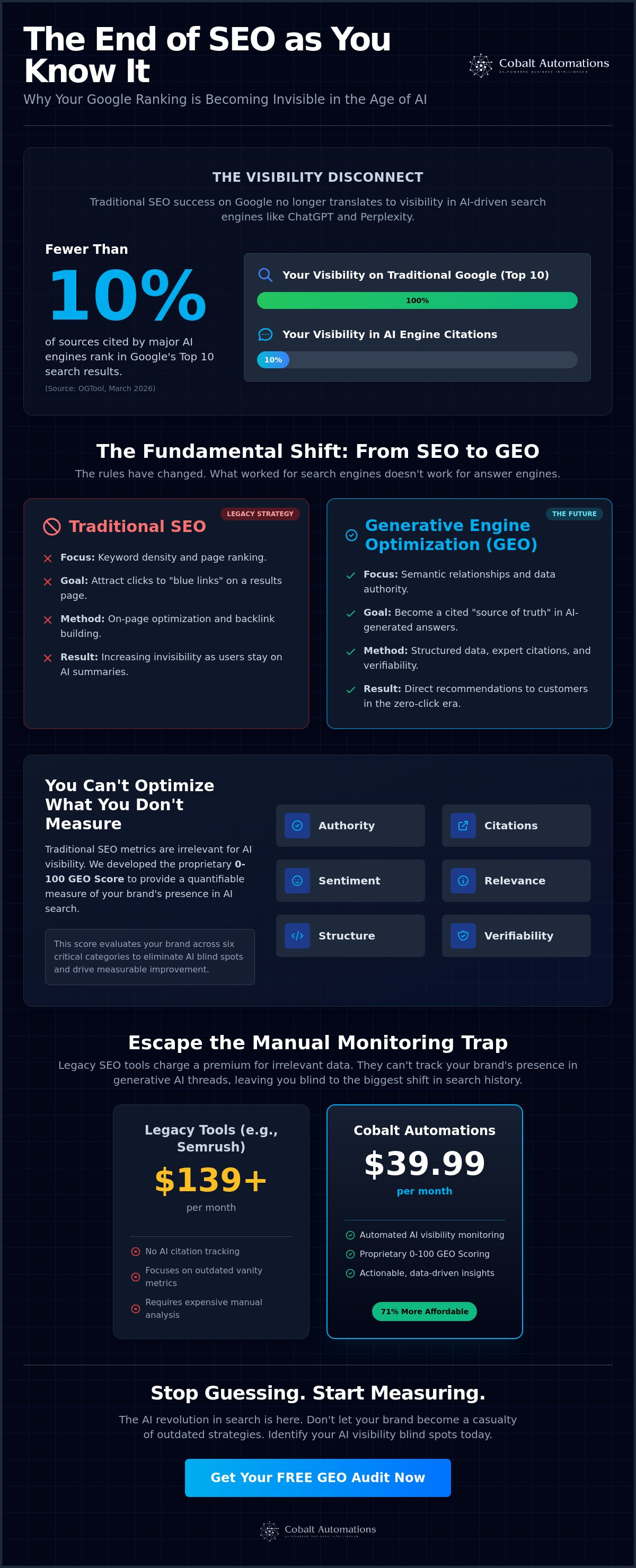
Fewer than 10% of the sources cited by major AI engines like ChatGPT and Perplexity actually rank in the top 10 of traditional Google search results. Think about that. Your legacy SEO strategy is likely building a bridge to a world that no longer exists. If you aren't visible in the generative response, you don't exist to the 58% of consumers who now use AI for product recommendations. This invisibility is the direct result of ignoring generative engine optimization.
You feel the decline in organic traffic. You see the AI Overviews pushing your links further down the page. It’s a digital wake-up call. This guide will expose the five dangerous myths keeping your brand in the shadows. We will break down the fundamental shift from ranking pages to securing citations. You’ll discover how to use a proprietary 0-100 GEO scoring system to audit your brand across six critical categories. Most importantly, we’ll show you how to monitor this new frontier for just $39.99 a month, proving that AI visibility doesn't require the $139 monthly price tag of legacy tools like Semrush.
Key Takeaways
- Stop relying on page-one rankings. Discover why traditional SEO results don't translate to visibility in ChatGPT or Perplexity.
- Learn how generative engine optimization focuses on semantic relationships and citation signals rather than outdated keyword-stuffing tactics.
- Identify the "manual monitoring trap" and why legacy tools costing $139/mo fail to track your brand's presence in generative AI threads.
- Use a proprietary 0-100 GEO scoring system to measure your business across six categories and eliminate critical AI blind spots.
- Implement immediate, data-driven changes to your content formatting to meet the specific "preferences" that LLMs use to select cited sources.
The SEO Delusion: Why Ranking #1 on Google No Longer Guarantees Discovery
Traditional search is dying. It's a hard truth that many business owners are slow to accept. You might spend thousands of dollars every month to hit the top of Google, only to find your traffic cratering. Why? Because ChatGPT, Perplexity, and Claude are the new gatekeepers. According to Brandi AI (June 2026), 58% of consumers now use generative AI instead of traditional search for product and service recommendations. If you aren't in the AI's response, you're invisible. You're paying for a ranking that no one sees because the user never scrolls past the AI summary.
There's a dangerous myth that ranking on page one of Google makes you visible to AI models. It doesn't. Research from OGTool in March 2026 found that fewer than 10% of sources cited by major AI engines also rank in Google’s top 10 results. AI models don't just scrape the top of the search engine results page. They synthesize data from across the web, often bypassing high-ranking sites to find more authoritative, structured data. This reality renders traditional SEO insufficient for modern discovery. You need a strategy that targets the LLM's logic, not just Google's crawler.
Defining Generative Engine Optimization for the 2026 Landscape
Generative engine optimization (GEO) is the tactical alignment of content for LLM retrieval and synthesis. It focuses on citation frequency and brand authority within agentic search results. Unlike SEO, GEO requires your brand to be the "source of truth" for the model. We measure this using a proprietary 0-100 GEO scoring system. This system evaluates your brand across six specific categories to ensure you're actually being recommended by the engines that drive today's market.
The Rise of Zero-Click AI Search
The "blue link" era is over. Users want the AI to provide a summary rather than hunting through five websites. This creates a zero-click environment. If your brand isn't cited in that summary, you don't exist to the buyer. This shift from "search engine" to "answer engine" changes everything for Pooler businesses. Legacy tools like Semrush charge $139 a month for irrelevant data. Cobalt Automations offers automated monitoring for just $39.99 a month. Start with a free GEO audit at cobaltautomations.com to fix your blind spots.
Myth: AI Search Engines Are Just Smarter Keyword Trackers
Stop counting keywords. It’s a legacy habit that creates a false sense of security. If you think stuffing "generative engine optimization" into your headers will win you a recommendation in Perplexity, you’re mistaken. Large Language Models (LLMs) don’t operate on keyword density. They operate on semantic relationships and data authority. They aren't looking for matches; they’re looking for answers. Traditional SEO tools focus on how often you say a word. AI engines focus on how well you explain a concept.
When ChatGPT or Claude synthesizes a response, it prioritizes structured data, expert citations, and verifiable statistics. It looks for "source of truth" signals. If your content is just a collection of high-volume phrases with no depth, the AI will bypass you for a competitor who provides actual data. This is the gap where brands die. Your SEO dashboard says you’re winning because you rank for a term. Your revenue says otherwise because the AI isn't citing you. You're invisible in the only place that matters.
The 0-100 GEO Scoring System Explained
You cannot optimize what you aren't measuring. At Cobalt Automations, we've replaced vague SEO metrics with a proprietary 0-100 GEO scoring system. This diagnostic evaluates your brand across six critical categories: Authority, Citations, Sentiment, Relevance, Structure, and Verifiability. A high SEO score does not correlate with a high GEO score. In fact, many "SEO-optimized" sites fail our audit because they lack the technical structure LLMs require. Total online review volume grew by 13% in 2024 according to Birdeye; this is the raw data AI uses to judge your authority. Business owners need a quantifiable metric to identify these blind spots before they lead to total market erasure.
Beyond Keywords: The Power of Semantic Authority
AI models map concepts. They want to know the "why" and "how" behind your business, not just the "what." This is semantic authority. To achieve it, your website must use structured data, specifically Schema.org, to help LLMs parse your information without friction. If the AI has to guess what you do, it will ignore you. We build websites specifically for this retrieval architecture. It’s about moving from being a "link" to being a "fact" in the AI's database. You can get a baseline visibility score to see where your semantic authority stands today. Don't wait for your traffic to hit zero before you start measuring what matters.
The Manual Monitoring Trap: Why Semrush and Legacy Tools Fail
You’re likely checking your SEO dashboard every morning. You see green arrows. You see keyword rankings holding steady. You think you’re safe. You aren’t. Traditional trackers like Semrush or Ahrefs are designed for a world of static blue links. They don't see what ChatGPT says about your brand in a private thread. They can’t track how Perplexity synthesizes your data into a recommendation. Relying on legacy tools for generative engine optimization is like using a map from 1995 to navigate a city built last year. It’s a dangerous delusion that leaves you invisible to 58% of your potential customers.
Legacy tools are expensive anchors. Paying $139 or more every month for data that ignores the AI revolution is a strategic failure. Most small to mid-sized firms can't justify that cost, especially when the data is irrelevant to modern discovery. Cobalt Automations provides the first automated AI search visibility monitoring for just $39.99 a month. We don’t just track links; we track citations, sentiment, and your 0-100 GEO score across the engines that actually drive revenue. You need a tool that speaks the language of LLMs, not just Google's crawler.
Automation vs. Manual Audits
AI models are not static. They update their training weights and retrieval patterns constantly. Google's May 2026 broad core update proved that search environments shift in days, not months. If you’re relying on a manual audit once a month, you’re already a month too late. Automated monitoring is the only way to catch visibility drops in real-time. Why pay Semrush $139.99 a month for broad, non-specialized data when you can get specialized AI tracking for $39.99? Automation removes the guesswork. It gives you the transparency needed to correct course before your lead flow dries up.
The Hidden Costs of Invisibility
Invisibility isn't a neutral state; it’s a financial drain. Every time a buyer asks an AI for a recommendation and your name is missing, you’ve lost a sale. This is especially critical for local Pooler businesses. Local AI search displacement is real. If an AI agent recommends your competitor because their data structure is better, your Google ranking won't save you. You can read more about The High Cost of Ignoring GEO Optimization in 2026 to understand these trends. Stop guessing and start measuring. Visit cobaltautomations.com for a free GEO audit and secure your brand's future.
Myth: Content Quality is Subjective to AI Models
Your definition of "quality" is irrelevant. It doesn't matter if your blog post wins a literary award if an LLM cannot parse your data. AI models don't have "taste." They have retrieval preferences. There's a persistent myth that writing "good" content for humans naturally leads to AI discovery. It's a lie that leaves your business invisible. LLMs like ChatGPT and Claude prioritize specific data formatting and citation signals over creative prose. If you aren't engineering your content for machine synthesis, you aren't doing generative engine optimization.
Industry data shows that pages integrating specific quotes and verifiable statistics see a 30-40% boost in AI visibility. Competitors like Semrush acknowledge this fact, yet they charge $139 or more a month for tools that don't actually help you implement these changes at a technical level. We do things differently. Cobalt Automations treats content as a technical asset. We engineer your site to be the definitive "source of truth" for LLM retrieval, ensuring your brand is the one being synthesized into the final answer.
The Anatomy of an AI-Optimized Page
AI engines are answer engines. They don't want to hunt for information; they want it served on a silver platter. This requires direct, declarative answers at the very top of your pages. You need to include unique data points and expert quotes that the model can easily extract and credit. For a deep dive into these structures, see our Generative Engine Optimization Definition. This isn't just about "better" writing. It's about building an architecture of authority that earns the citation every single time.
Earning the Citation: The New Backlink
In the GEO era, a citation in a ChatGPT response is worth more than a dozen backlinks from stagnant blogs. AI models use your "About" and "Service" pages as primary training data for local queries. If your data isn't structured correctly, the AI will recommend someone else. Even "unlinked brand mentions" are now a primary currency of AI authority. The model knows who you are even if there's no blue link. We provide the transparency you need to track these mentions across the web. While legacy SEO tools leave you in the dark, our automated monitoring gives you a clear 0-100 GEO score for just $39.99 a month. You can get your free GEO audit now to see exactly how AI models perceive your brand's quality.
Reclaiming Your Future: How to Start Your GEO Transition Today
The window of opportunity is closing. Every day you delay, your competitors are cementing their status as the "source of truth" in the training data of LLMs. You cannot optimize what you aren't measuring. Stop flying blind. To reclaim your brand's future, you need a methodical approach to generative engine optimization. It starts with a diagnostic, moves into competitive gap analysis, and concludes with technical deployment. This isn't a "set and forget" strategy. It's a fundamental shift in how your business exists online.
Success requires three immediate steps. First, get a baseline visibility score. Use our 0-100 GEO scoring system to see how ChatGPT, Perplexity, and Claude currently perceive your authority. Second, identify the visibility gaps. If a competitor is being cited for your primary service, you need to know exactly why. Is it their data structure? Their citation volume? Third, deploy GEO-optimized landing pages. These aren't just "web pages." They are retrieval assets engineered specifically for LLM synthesis. You can start this process right now by visiting Cobalt Automations for a free GEO audit.
The Cobalt GEO Monitoring Subscription
Visibility is a moving target. It isn't a one-time achievement. AI models update constantly, and your monitoring must keep pace. Our automated subscription provides ongoing tracking of your brand mentions across the entire AI landscape. We deliver affordable, automated visibility scores directly to your inbox. At $39.99 a month, this service replaces the need for a full-time SEO consultant or a bloated $139 monthly Semrush subscription. It’s about precision. We give you the data you need to stay visible without the legacy overhead. You get total transparency into your AI "blind spots" before they impact your bottom line.
Building Your GEO-Optimized Website
Don’t just update your content. Update your architecture. Traditional websites are built for human eyes and Google’s legacy crawlers. A GEO-optimized website is built for machine retrieval. It uses advanced schema and structured data to ensure an LLM never has to guess your expertise. Check out our GEO Optimized Website Examples to see the future of web design. The transition from traditional search to AI-driven discovery is a one-way street. The businesses that adapt now will own the answers of tomorrow. Those that wait will simply disappear from the digital record. The choice is yours: be the answer or be invisible.
Stop Funding Your Invisibility and Secure Your AI Authority
The era of hiding behind a page-one Google ranking is over. Your business is either the source of truth for an AI response or it is invisible. We've exposed the myths keeping you in the dark. Legacy SEO tools are expensive anchors. Keywords are a distraction from semantic authority. True generative engine optimization requires an architecture built for machine retrieval and a constant pulse on how LLMs perceive your brand. Don't let your business become a digital ghost.
You need transparency. Our proprietary 0-100 GEO scoring system identifies your blind spots across six critical categories. We provide the first automated monitoring solution for just $39.99 a month. This gives you the real-time data needed to stay ahead of the curve. Whether you require a specialized GEO-optimized website design or a diagnostic of your current presence, the path forward is clear. Take the first step toward reclaiming your discovery. Get Your Free GEO Audit at Cobalt Automations today. The future of your brand depends on being the answer the AI gives. You have the tools to win; now it's time to use them.
Frequently Asked Questions
What is the main difference between SEO and Generative Engine Optimization?
SEO focuses on ranking links in a list. Generative engine optimization focuses on securing citations within an AI's generated response. Traditional search wants you to click a link. AI search wants to summarize your expertise directly. SEO targets keyword density; GEO targets semantic authority and structured data retrieval. You aren't just trying to be seen; you're trying to be the answer.
How does the 0-100 GEO scoring system work?
Our proprietary system evaluates your brand across six specific categories. These include Authority, Citations, Sentiment, Relevance, Structure, and Verifiability. We analyze how LLMs parse your data and assign a score based on your likelihood of being recommended. High SEO rankings don't guarantee a high GEO score. You need a quantifiable metric to find your blind spots before they cost you revenue.
Can I track my AI search visibility for free?
You can get a free initial baseline audit at cobaltautomations.com. However, tracking ongoing visibility manually is a trap. AI responses are personalized, private, and highly dynamic. You cannot see what ChatGPT or Claude says about your brand across thousands of threads without automated monitoring. Our system provides the transparency you need to stop flying blind in a changing market.
Why is Cobalt Automations cheaper than Semrush for AI tracking?
We are a specialized, automated service. Legacy tools like Semrush carry massive technical debt and overhead, leading to pricing that often starts at $139 a month. We focus exclusively on AI visibility. By automating the retrieval and scoring process specifically for LLMs, we provide superior GEO data for just $39.99 a month. It’s specialized precision versus generalized legacy bloat.
Does GEO replace traditional SEO entirely?
It doesn't replace it; it transcends it. SEO still handles legacy search traffic. However, with 58% of consumers now using AI for recommendations according to Brandi AI (June 2026), GEO is the new priority for brand discovery. If you only focus on SEO, you're ignoring the majority of the modern market. You need a strategy that covers both the legacy blue link and the modern AI summary.
How long does it take to see results from GEO optimization?
Technical architecture updates can reflect in AI retrieval within 30 to 60 days. Earning consistent citations requires building verifiable authority and structured data that models can trust. Unlike Google rankings, which can fluctuate daily based on algorithm tweaks, AI citations are based on the model's retrieval weights. Start your transition today to secure your place in the next wave of model updates.
What AI search engines does Cobalt Automations monitor?
We track your brand across all major players in the generative space. This includes ChatGPT, Perplexity, Google Gemini, Anthropic’s Claude, and xAI’s Grok. Each engine has different retrieval preferences and data sources. Our monitoring ensures you have a high visibility score across the entire landscape, protecting you from being cited by one engine but ignored by another.
Is my business too small to need Generative Engine Optimization?
No business is too small for discovery. In fact, small businesses are most vulnerable to AI displacement. If a local customer asks an AI for a service provider and your data isn't structured for retrieval, the AI will recommend a competitor who has done the work. GEO is the only way to ensure you aren't erased from the local search market as consumers move away from Google.