
Nearly 60% of digital searches now end without a single click. It's a sobering statistic that should haunt every business owner planning a site refresh. You spend thousands on a sleek new look, only to realize that ChatGPT and Claude don't care about your color palette. If these models can't parse your data, your brand stays invisible. You're right to feel uneasy about losing your hard-earned search authority during a transition. It's a high-stakes gamble you can't afford to lose.
This article will show you how to turn that anxiety into a competitive edge. You'll learn exactly how GEO monitoring informs website redesigns to ensure your brand is cited as a primary source by generative engines. We'll explore our proprietary 0-100 GEO scoring system that evaluates your site across six essential categories. While traditional tools charge $139 or more for basic data, you'll discover how to automate your AI visibility for just $39.99 a month. It's time to stop designing for yesterday's web and start building for the AI-first era.
Key Takeaways
- Identify why traditional website redesigns often lead to "AI Erasure" and how to ensure your brand remains visible to engines like ChatGPT and Claude.
- Use the proprietary 0-100 GEO scoring system to benchmark your site authority across six critical categories before you change a single line of code.
- Learn how GEO monitoring informs website redesigns by replacing outdated human heatmaps with high-impact LLM retrieval data.
- Implement a two-phase roadmap that aligns your technical backend with AI crawler requirements for a successful, AI-ready launch.
- Establish a continuous monitoring strategy to maintain your competitive edge as generative models update their knowledge bases in real-time.
The Invisible Failure: Why 2026 Website Redesigns Often Kill Brand Visibility
Business owners are walking into a trap. They spend tens of thousands on sleek aesthetics and high-end UX, thinking they've secured their future. They haven't. While your site might look stunning to a human, it's often a tangled mess to the AI engines that now gatekeep discovery. Traditional Search engine optimization (SEO) focuses on ranking blue links, but that era is over. As of early 2026, ChatGPT has over 900 million weekly active users. These people aren't clicking links; they're asking questions and receiving answers. If your new design breaks the data structures these models rely on, your brand simply ceases to exist in the conversation.
This is the "Redesign Trap." You prioritize a minimalist layout that pleases your eye but strips away the semantic context AI needs. Your GA4 dashboard might show healthy traffic for now, but your AI visibility is likely cratering. Understanding how GEO monitoring informs website redesigns is the only way to avoid this invisible failure. Generative Engine Optimization (GEO) monitoring is the continuous tracking of your brand's presence within AI responses. It's the digital pulse of your business in an era where AI models update their knowledge daily. Without it, you're redesigning in the dark. Common redesign errors that kill visibility include:
- Minimalist layouts that strip away descriptive, context-rich text.
- Broken or missing schema markup that confuses AI crawlers.
- JavaScript-heavy designs that prevent efficient content extraction.
- Removal of high-value FAQ sections that serve as "bite-sized" data for LLMs.
The Shift from Clicks to Citations
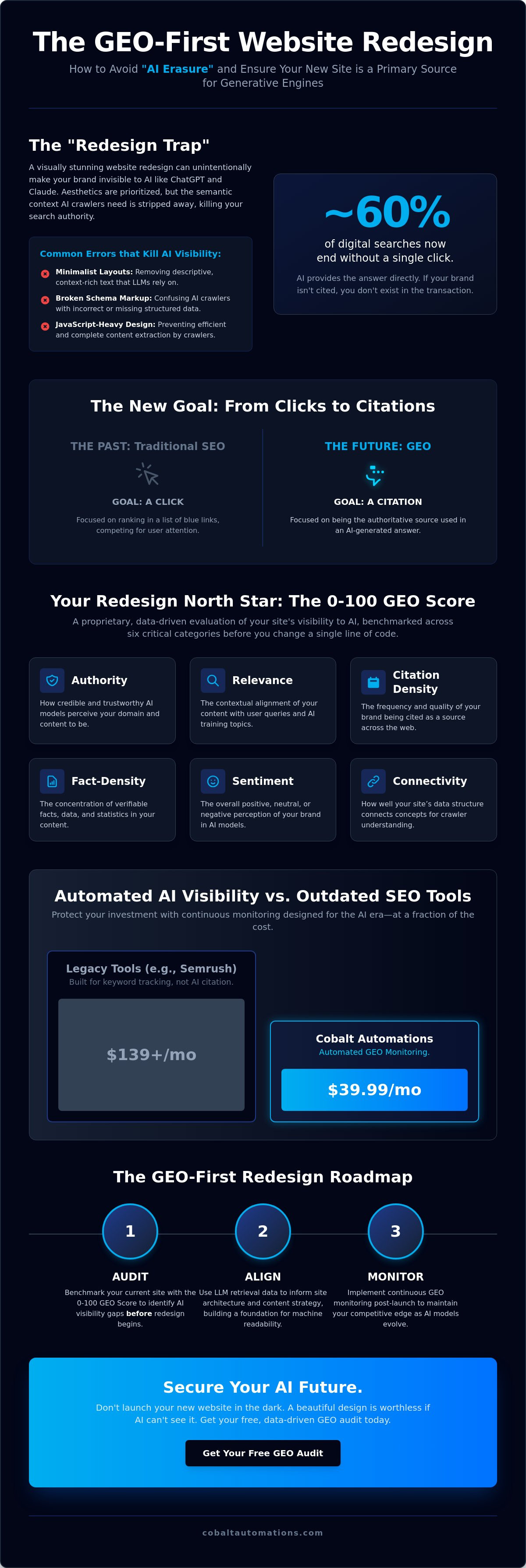
The old goal was a click. The new goal is a citation. Nearly 60% of searches now end without a single click because AI provides the answer directly. If an LLM doesn't cite your brand, you're locked out of the transaction. AI search visibility is about being the most credible source in the "RAG" (Retrieval-Augmented Generation) window. If you aren't in that data pool, you don't exist. Cobalt Automations uses a proprietary 0-100 GEO scoring system to ensure you're always part of the answer.
Why Traditional SEO Tools Leave You Blind
Legacy tools like Semrush were built for a different world. They track keywords, but they can't tell you how Claude or Perplexity perceives your brand authority. They're expensive, often costing $139 or more monthly for data that doesn't drive AI discovery. Cobalt Automations offers a straight-shooter alternative at $39.99 a month. We provide the automated monitoring you need to protect your investment. This is how GEO monitoring informs website redesigns for the modern era. Visit cobaltautomations.com to check your score before you launch.
Decoding the AI Lens: How GEO Monitoring Scores Dictate Your New Site Architecture
Most business owners start a redesign by looking at wireframes. They obsess over hero banners and button colors. This is a strategic error. In the AI-first era, your site architecture must be built for machine retrieval first and human browsing second. This shift represents a fundamental shift from SEO to LLM optimization. If ChatGPT or Claude can't find the "skeleton" of your data, your beautiful new design is just an expensive digital paperweight. This is exactly how GEO monitoring informs website redesigns; it provides the diagnostic data needed to build a site that AI can actually "read."
Analyzing the 0-100 GEO Score
At Cobalt Automations, we use a proprietary 0-100 GEO scoring system to serve as your redesign North Star. This isn't a vanity metric. It's a rigorous evaluation across six specific categories: Authority, Relevance, Citation Density, Fact-Density, Sentiment, and Connectivity. Before you commit to a new layout, you must run a free GEO audit to identify "content dead zones." These are sections of your site that AI models currently ignore. A low score in "Connectivity," for example, signals that your internal linking is too shallow for an LLM to follow. You don't need better copy in that case; you need a structural overhaul.
From Data Points to Design Choices
Once you have your scores, your design choices become objective. If your "Citation Density" is low, your new architecture must prioritize structured data and FAQ modules over large, text-heavy blocks. We call this designing for Retrieval-Augmented Generation (RAG) efficiency. AI models look for "chunks" of verified information they can easily pull into a response. While legacy tools like Semrush charge $139 or more per month for keyword data that ignores these nuances, Cobalt Automations provides automated monitoring for just $39.99 a month. We help you map high-performing AI citations directly to your new primary navigation. This ensures that the most "citable" parts of your business are the easiest for AI to find.
Your goal is transparency, not obscurity. Hidden metadata and clean schema markup are now more valuable than your "above-the-fold" hero banner. If a redesign doesn't improve your GEO score, it's a failure. Use these metrics to justify your redesign costs and ensure you aren't just buying a prettier version of an invisible website. Check your current standing with a free GEO audit before your developers write a single line of code.
Beyond Heatmaps: Using LLM Retrieval Data to Inform Content Strategy
Traditional designers obsess over heatmaps. They track where humans click, scroll, and linger. While that matters for conversion, it's useless for discovery if your site never appears in an AI response. If you're only designing for human eyes, you're ignoring the most important "user" of 2026: the Large Language Model (LLM). This is where the concept of Generative Engine Optimization (GEO) becomes your most powerful asset. You need to understand how an AI "experiences" your site before a human ever gets the chance.
Marketing fluff is a liability in the AI era. LLMs prioritize "Semantic Density," which is the concentration of factual, verifiable information within your content. When we analyze how GEO monitoring informs website redesigns, we look for fact-dense blocks that serve as definitive answers to user queries. If your current site is buried in vague adjectives and corporate jargon, AI engines like Perplexity or SearchGPT will pass you over for a competitor who provides raw value. Our proprietary 0-100 GEO scoring system specifically measures this "Fact-Density" to ensure your redesign doesn't just look better, but actually communicates more effectively to machines.
Content Engineering for AI Discovery
We've moved past simple copywriting into content engineering. Your redesign must prioritize technical data formatting that earns brand citations. This isn't about "SEO Optimization Services," which focus on yesterday's blue links. It's about "website creation geo optimized" for retrieval. Cobalt Automations builds structures that allow AI crawlers to extract information with zero friction. We ensure your brand claims are formatted as "citable nuggets" that LLMs find credible. While tools like Semrush charge $139 or more per month for keyword tracking, our $39.99/mo subscription provides the automated monitoring you need to stay in the AI's "inner circle."
Identifying and Fixing AI Blind Spots
GEO monitoring reveals exactly where your brand is invisible. By tracking AI responses in real-time, you can see which specific questions your competitors are answering while you remain silent. These are your "AI Blind Spots." Use this data to fuel your new content calendar. Don't guess what people want to know; look at what the AI is currently failing to find on your site. You can see examples of GEO-optimized structures to understand how high-performing sites organize their data. A redesign informed by these gaps ensures that your post-launch site isn't just a fresh coat of paint, but a strategic weapon for market dominance.
The GEO-First Redesign Roadmap: From Audit to AI-Ready Launch
Redesigning your website without a data-backed roadmap is digital suicide. Most business owners treat a site refresh like a cosmetic surgery. They focus on the surface while the internal organs fail. If you want to survive the transition from traditional search to AI discovery, you must follow a structured, five-phase roadmap. This systematic approach is how GEO monitoring informs website redesigns from the very first wireframe to the final deployment. It ensures that your new site is a citable asset for LLMs, not just a pretty face for humans.
Step 1: The GEO Baseline
Don't move a single pixel until you know your current AI visibility score. You need to run a 0-100 GEO score report to understand how models like ChatGPT and Claude currently perceive your brand authority. This baseline report evaluates you across six critical categories, including Fact-Density and Citation Density. If your current score is below 50, your redesign must be a structural overhaul, not a simple reskin. Comparing your score against industry benchmarks reveals exactly where your digital blind spots are. You wouldn't build a house on a cracked foundation; don't build a website on an invisible brand profile.
Once the baseline is set, you move into technical alignment and content authority mapping. This involves ensuring your backend is optimized for AI crawlers and building the specific pages that generative models want to cite. While legacy tools like Semrush charge $139 or more per month for keyword data that ignores AI retrieval, Cobalt Automations provides the automated guardrails you need for just $39.99 a month.
Step 4: The AI Stress Test
Testing in a vacuum is a mistake. Before you launch, you must put your new structure through an AI stress test in a beta environment. This phase uses real-time tracking to see how LLMs retrieve information from your new navigation and data hierarchies. If the models can't find your primary brand claims in the staging environment, they won't find them in the wild. This is a critical part of our Generative Engine Optimization Services. You have the chance to adjust content and technical schema based on real-world AI visibility data before the public ever sees the site.
The final phase is post-launch optimization. A redesign is a moment in time, but AI models update constantly. Continuous monitoring acts as a $39.99/mo insurance policy against "AI Erasure." It ensures that your hard-won search authority doesn't evaporate the moment your new site goes live. Start your journey by securing a free GEO audit today to see where you stand.
Securing Your Digital Future: Why Continuous GEO Monitoring is Non-Negotiable
A website redesign is a static event. It's a snapshot of your brand at a single point in time. Artificial intelligence is the opposite. Models like ChatGPT, Claude, and Perplexity update their knowledge bases daily; sometimes hourly. If you treat your redesign as a "set it and forget it" project, you're inviting digital decay. You wouldn't spend $20,000 on a high-end security system and then leave the front door wide open. Protecting that investment requires more than just a successful launch. It requires a guardrail against "AI Erasure."
AI Erasure happens when a model decides your content is no longer the most authoritative or fact-dense source available. It can happen overnight. One technical glitch in your new schema or a competitor's aggressive content update can drop your visibility to zero. Understanding how GEO monitoring informs website redesigns doesn't end on launch day. It's a continuous feedback loop. Cobalt Automations is the first automated service built specifically for this battle. We provide the transparency you need to see exactly how AI engines perceive your brand every single day.
Automated vs. Manual AI Tracking
Manual checking is a trap for amateurs. You don't have the time to sit at a desk and manually prompt five different LLMs to see if your brand is still being cited. It's a waste of executive resources. Cobalt Automations replaces this guesswork with automated visibility scores and real-time brand mention alerts. While legacy SEO suites like Semrush charge $139 or more per month for data that ignores generative engines, we offer a focused alternative for just $39.99 a month. We track your proprietary 0-100 GEO score across all six categories, ensuring your redesign maintains its competitive edge long after the developers have moved on.
Staying Ahead of the AI Evolution
The AI landscape moves faster than any traditional search algorithm ever did. This long-term visibility is exactly how GEO monitoring informs website redesigns for businesses that intend to lead, not follow. It allows you to make precise, data-driven micro-updates to your site based on real-time retrieval data. If your "Authority" score dips, you know exactly which section of your site needs more fact-density. You stay proactive rather than reactive. Don't let your new site become a relic of the past. Get your free GEO audit at cobaltautomations.com and secure your brand's place in the AI-first era.
Secure Your Brand Seat in the Generative Future
A website redesign without data is just a high-stakes gamble. You've seen how legacy SEO tools leave you blind to how ChatGPT, Claude, and Perplexity actually perceive your authority. By using our proprietary 0-100 GEO scoring system, you move from guesswork to precision. You now understand how GEO monitoring informs website redesigns by highlighting semantic gaps and structural failures before they cost you revenue. Don't let your new site become a digital ghost.
Cobalt Automations is the first automated AI search visibility service designed to protect your investment for just $39.99 a month. It's time to stop worrying about blue links and start winning the citation battle. We give you the clarity to lead your industry while competitors are still stuck in the traditional search era. Your brand deserves to be discovered by the next generation of users. A proactive strategy is the only way to ensure your redesign pays off.
Claim Your Free GEO Audit & Protect Your Redesign at cobaltautomations.com
Take the first step toward total AI visibility today. You've built a great business; now make sure the world's most powerful engines can find it.
Frequently Asked Questions
What is the difference between SEO and GEO monitoring?
Traditional SEO tracks your position in a list of blue links. GEO monitoring tracks your brand's presence in AI-generated answers. It's the difference between being a link on page one and being the actual answer ChatGPT gives a user. We focus on how your data is retrieved and cited by models, not just how it's indexed by Google.
How does a website redesign affect my visibility in ChatGPT?
A redesign can wipe out your AI visibility overnight. If you change your site's architecture without understanding how GEO monitoring informs website redesigns, you risk breaking the technical schema AI engines use to parse your authority. Your site might look better to humans, but if ChatGPT can't find your core brand claims, you've effectively vanished from the AI search era.
What are the six categories of the 0-100 GEO score?
Our proprietary 0-100 GEO score evaluates your site across six critical categories: Authority, Relevance, Citation Density, Fact-Density, Sentiment, and Connectivity. These metrics quantify how "citable" your content is for generative engines. High scores in these areas ensure that LLMs like Perplexity and Claude prioritize your brand as a primary source of information during retrieval.
Can GEO monitoring help if my website is already live?
Absolutely. Monitoring a live site is the only way to identify "AI Blind Spots" where competitors are out-citing you. It provides a real-time diagnostic of your brand's authority. You can use these insights to make surgical updates to your content rather than guessing why your traffic is stagnating. It's a proactive guardrail for any existing digital presence.
Why is Cobalt Automations cheaper than Semrush or Ahrefs?
Cobalt Automations is the first automated service specifically engineered for AI search visibility. We don't charge for bloated, legacy SEO features that are becoming irrelevant in the generative era. By focusing strictly on GEO metrics, we provide a high-impact solution for just $39.99 a month. Compare that to the $139 or more you'd pay for traditional tools like Semrush.
How often should I monitor my brand’s visibility in AI search?
You should monitor your visibility continuously. AI models update their knowledge bases daily, meaning your brand's authority is never permanent. A "set it and forget it" approach leads to AI Erasure. Our automated system tracks your status in real-time, alerting you to shifts in citation velocity before they impact your bottom line.
Does GEO optimization require changing my entire website content?
No. Optimization is often about structural alignment and increasing "Fact-Density" rather than a total rewrite. It involves formatting your existing expertise into "citable nuggets" that LLMs can easily extract. We help you identify which specific pages are underperforming so you can make high-impact, technical adjustments without starting from scratch.
Will my traditional Google rankings drop if I optimize for AI?
No. GEO and SEO are complementary strategies. Both rely on strong E-E-A-T principles. Optimizing for AI retrieval actually improves your site's clarity and data structure, which traditional search engines also value. You're simply future-proofing your brand for the 60% of searches that now end without a click. Claim your free audit at cobaltautomations.com to see your score.